

Trans Day of Visibility 2026
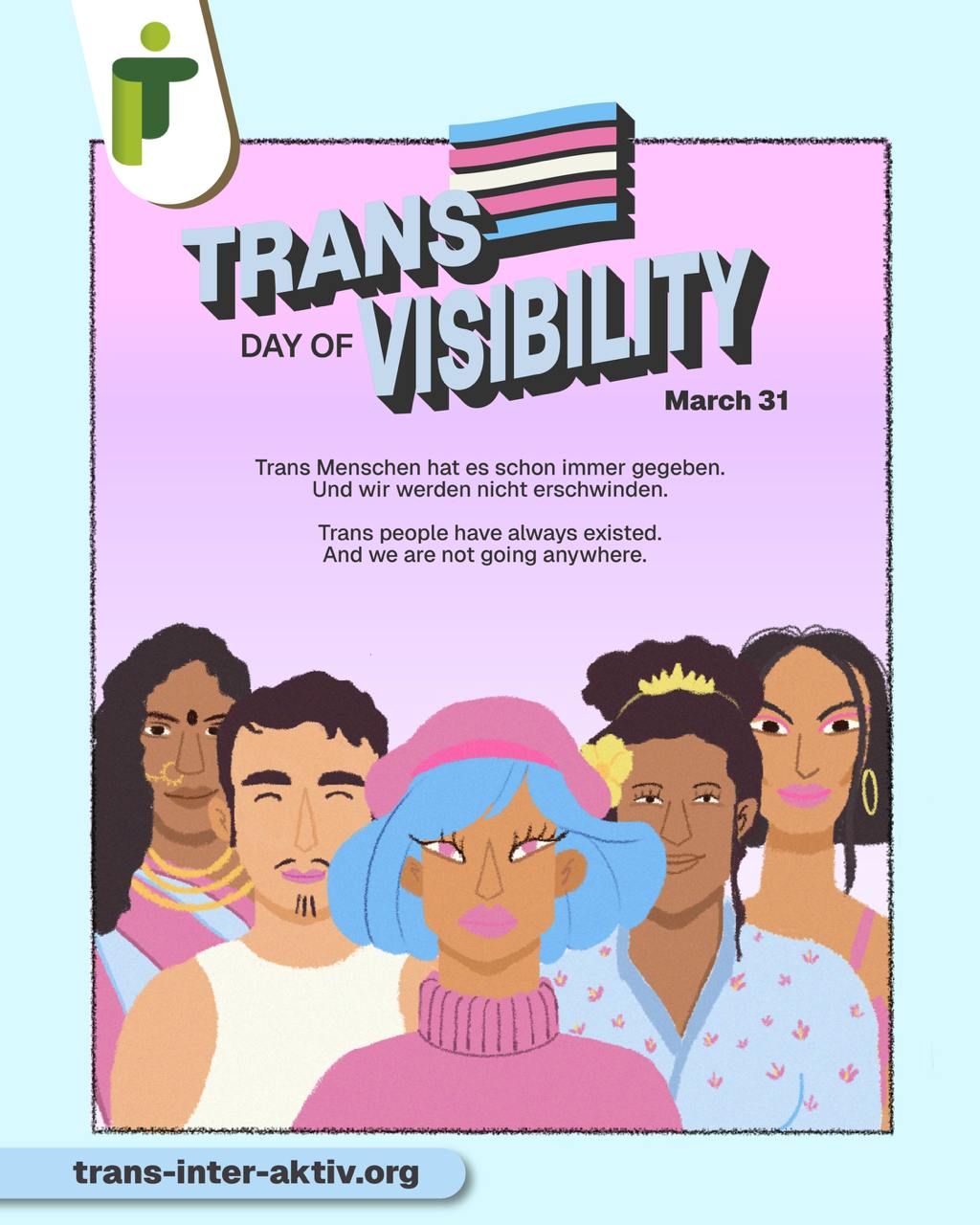
Trans Day of Visibility (TDOV) celebrates trans people around the world, recognizing their lives, experiences, and contributions to society. The day was founded in 2009 by activist Rachel Crandall-Crocker. It was created to provide a counterbalance to days of remembrance and to center trans life, joy, and self-determination.
Trans people have always existed—across cultures, continents, and centuries. Yet historically, trans lives have often been made invisible, pathologized, or actively suppressed.
Visibility means being seen and recognized as who we truly are. At the same time, it raises a fundamental question:
Who in our society has the ability to be visible—and under what conditions?
Not all trans people can live openly. Those with supportive families, legal protections, stable incomes, or access to urban environments often have more opportunities to be visible. For many others, visibility carries significant risks.
In rural areas or smaller towns—including in parts of Germany—living openly as a trans person can lead to isolation, discrimination, or open hostility. Many trans people must travel long distances to access specialized healthcare or supportive community spaces. For some, being visible may also increase the risk of losing employment, facing family conflict, or experiencing social exclusion.
Structural barriers are particularly common for trans feminine people, trans migrants, Black and trans people of colour, trans sex workers, trans people with disabilities, and those without financial stability. For many of them, being safely visible is far more difficult.
Visibility is therefore also a matter of privilege. Trans Day of Visibility highlights these different realities. It honors both those who are able to live openly and those who must protect their privacy and safety.
The day also reminds us that gender diversity has a long global history. Examples include Hijra communities in South Asia, Muxe or Muxhe in Mexico, Mamluk in Egypt, Fa’afafine in Samoa, Kathoey in Thailand and many more. These traditions show that gender diversity is not new and not a recent trend—it has always been part of human history and culture. (take a look at this map for more information: https://www.pbs.org/independentlens/content/two-spirits_map-html/)
At the same time, many of these communities continue to face marginalization, stigma, and violence. Visibility does not automatically lead to acceptance. However, it can help foster understanding and contribute to social change.
In Germany, trans rights also remain part of ongoing public and political debates. Progress in legal recognition and protections is often accompanied by social and political backlash. How a society treats trans people ultimately reflects how it treats diversity, self-determination, and human rights more broadly.
Trans Day of Visibility is therefore also a day for allies. Partners, family members, friends, colleagues, teachers, neighbours, and entire communities all play a role in supporting trans people and creating safer spaces.
Visibility is not only about being seen.
It is about dignity, safety, and the right to live as oneself.