

LGBTIQ Health Awareness Week
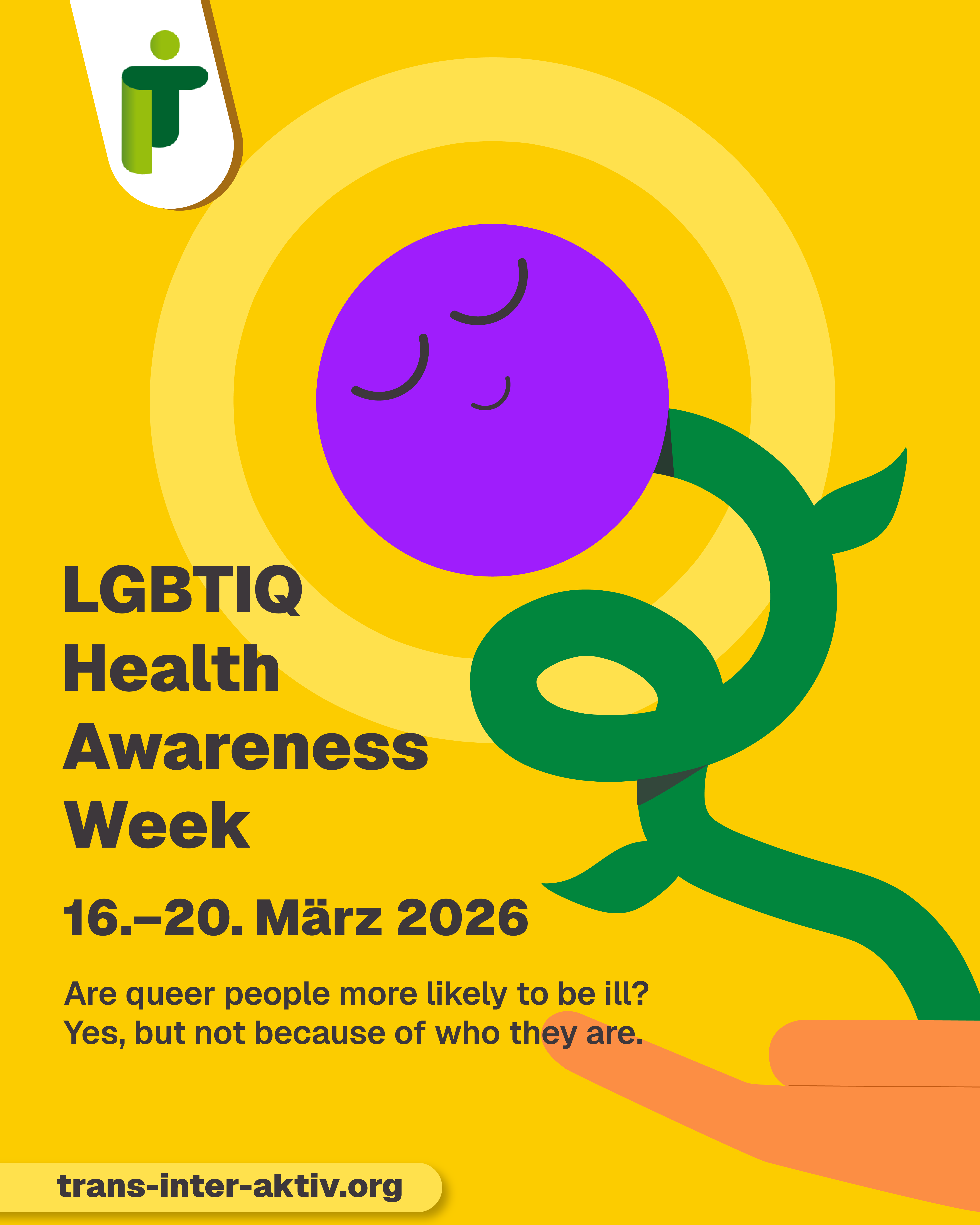
Are queer people more likely to be ill?
During the LGBTIQ Health Awareness Week (March 16–20, 2026) we want to highlight an important issue: health inequalities affecting queer communities.
Research shows that tian* people experience higher rates of both mental and physical health issues compared to cis and endosex people.
Mental health
Studies indicate higher prevalence of:
- sleep disorders
- burnout
- depression
- anxiety disorders
- suicide attempts
among trans, nonbinary and inter individuals compared to non-tian* populations.
Physical health
Physical health conditions are also more common. Research shows:
- roughly twice the rate of heart disease
- about 1.5 times more chronic back pain
- higher rates of migraine
compared to non-tian* people.
Discrimination as a health risk
These differences are not caused by queer identities themselves.
A key factor is social discrimination.
Many tina* people regularly experience:
- degrading comments
- rejection or misunderstanding
- social exclusion
These experiences create chronic stress, which directly affects both physical and mental health.
Violence and medical interventions
Members of the community are also disproportionately affected by physical violence.
Intersex people in particular have reported non-consensual medical interventions performed to conform bodies to societal norms. These interventions can have lifelong physical and psychological consequences.
Barriers in healthcare
Discrimination also occurs within healthcare systems.
TINA* people report experiences such as:
- intrusive or inappropriate questions
- lack of medical knowledge
- denial of treatment
As a result, many people avoid seeking healthcare or attend fewer preventive screenings.
A global development
Trans-specific healthcare is increasingly under political pressure worldwide.
In the United States, about half of the states have restricted access to gender-affirming healthcare for trans youth. In Russia, medical transition has been banned by law.
These developments highlight that the health situation of many tian* people is part of a broader global health and human rights issue.
What can be done?
Achieving health equity for queer people requires:
- discrimination-free healthcare
- improved medical education on trans and inter health
- legal protection against discrimination
- broader social acceptance
In the next article, we will discuss what concrete steps can help improve this situation.